Free Speech Movement (UC Berkeley)
Oct 1, 1964 - Jan 3, 1965
Berkeley, California
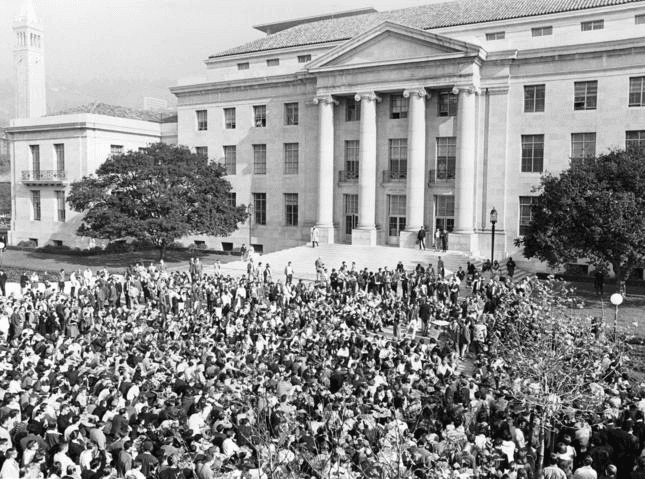
A police car sat immobilized in the middle of Sproul Plaza for 32 hours in October 1964, surrounded by thousands of University of California students who refused to let it move. That improvised standoff would ignite the Free Speech Movement, a protest that redefined the relationship between American universities and the students who attended them.[1]
Berkeley's rebellion did not emerge from nowhere. The Bay Area in the early 1960s had become one of the most politically active regions in the country, with civil rights organizing that rivaled anywhere outside the Deep South strongholds of Selma and Birmingham.[2] Students at UC Berkeley had thrown themselves into this work, joining groups like the Congress of Racial Equality and supporting the Student Nonviolent Coordinating Committee in campaigns against both southern segregation and discriminatory hiring practices closer to home.[2]
The university administration viewed this activism with growing unease. Campus rules had long required written permission before any political organizing could take place, effectively giving administrators veto power over student speech.[2] For years, a narrow strip of sidewalk at the campus entrance had served as a loophole, a space the administration claimed belonged to the city rather than the university, where students could distribute literature and recruit volunteers. Then, in September 1964, the university suddenly reversed its position, declaring the Bancroft Strip university property after all and banning the civil rights organizing that had flourished there.[2]
The confrontation came on October 1, when campus police arrested Jack Weinberg, a CORE activist, for handing out flyers on Sproul Plaza.[2] What happened next was unplanned and unprecedented. Students surrounded the patrol car and simply refused to move, trapping Weinberg and the officers inside. For the next day and a half, that police car became an improvised stage. Movement leaders climbed onto its roof to address the growing crowd, most memorably Mario Savio, whose speeches would come to define the movement's moral clarity.[1] One journalist who covered the events later observed that the Free Speech Movement had transformed how information traveled across the country, opening channels that had never existed before.[1]
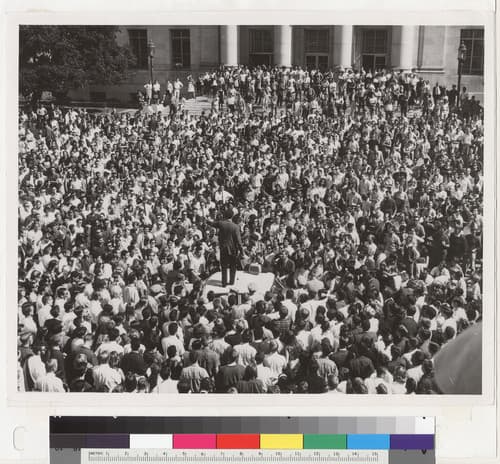
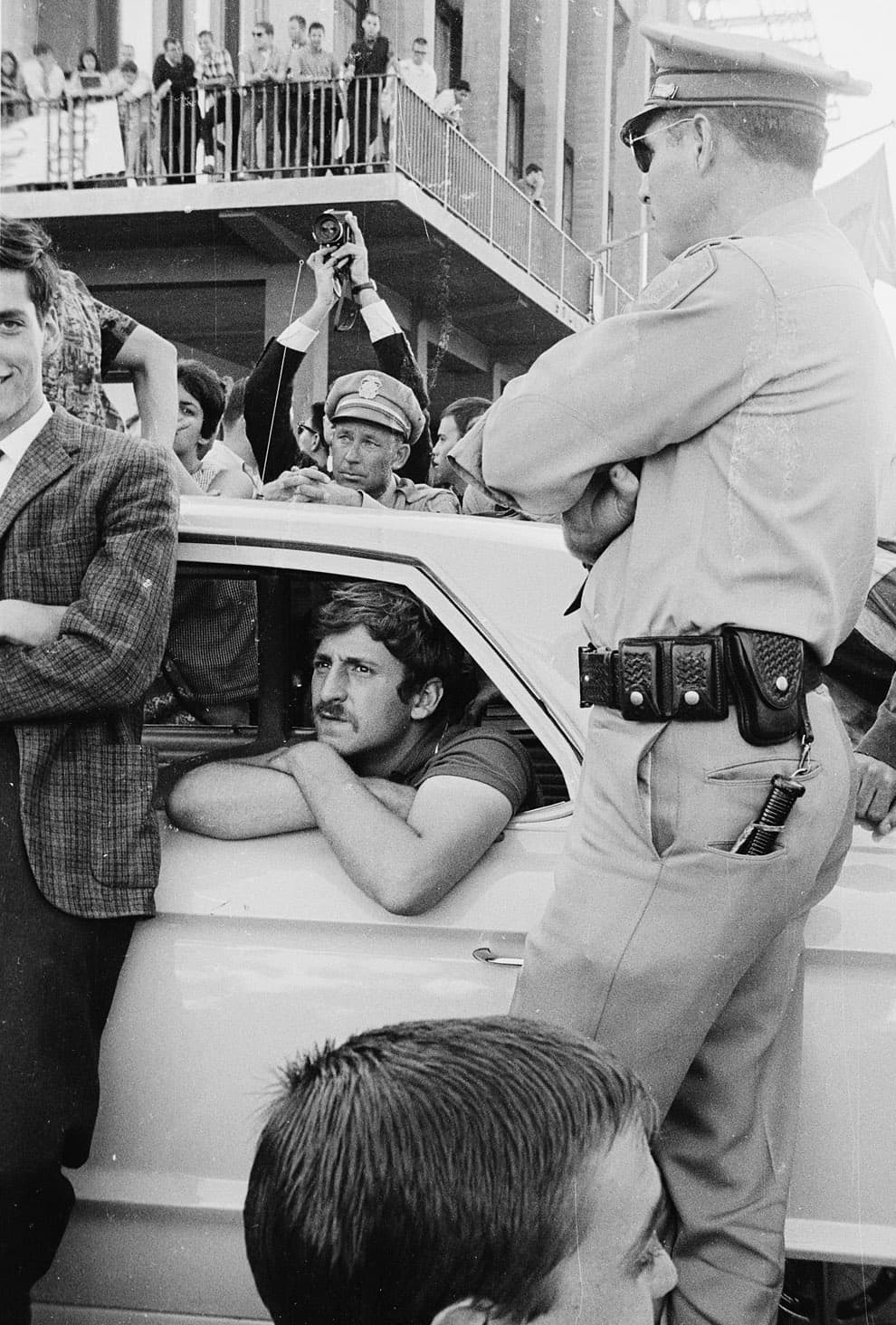
The Free Speech Movement grew through methods that reflected its democratic ideals: countless meetings, mimeographed pamphlets, and a commitment to persuasion over confrontation.[3] Oral histories collected years later revealed that the movement depended as much on hundreds of anonymous volunteers who typed, distributed literature, and staffed information tables as on its visible leaders.[1] These rank-and-file participants brought perspectives that later historians would work to recover, including the stories of students whose race or gender had long been overlooked in accounts of the period.[1]
Women in the movement discovered that fighting for free speech did not exempt them from the sexism of the era. Suzanne Goldberg, one of the female organizers, later described how her contributions were routinely dismissed in meetings, criticism she initially interpreted as evidence of her own inadequacy rather than recognizing it as a pattern of discrimination.[4] These frustrations, shared by women across the New Left, would eventually fuel the women's liberation movement of the following decade.
The university administration escalated the conflict in early December by pursuing disciplinary charges against movement leaders. Students responded on December 2 by occupying Sproul Hall, the main administrative building, in numbers exceeding 800.[1],[2] Governor Edmund G. Brown dispatched 600 police officers to clear them out, producing the largest mass arrest of students that America had ever witnessed.[2]
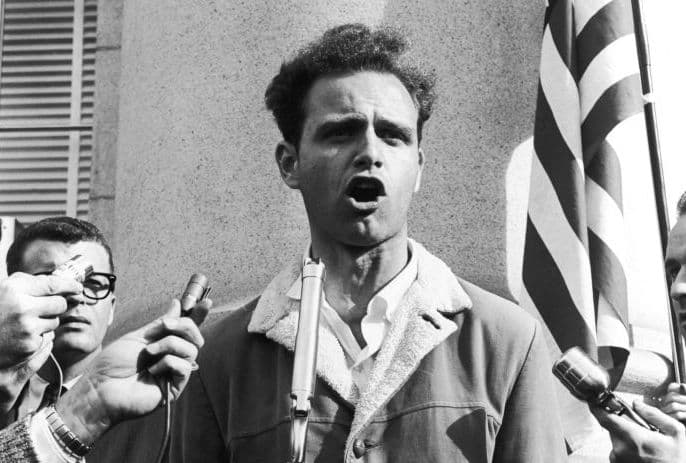
The arrests backfired on the administration. Rather than breaking the movement, the mass jailing of students shocked the campus into broader solidarity. A strike spread across the university, and faculty members who had remained neutral began passing resolutions in support of the protesters' demands.[4] Even students who had kept their distance found themselves confronting questions they had avoided. Charles Powell, the student body president, had given a speech during the police car standoff but later admitted he felt disconnected from the intensity that drove his peers, an ambivalence that captured how the FSM divided Berkeley between those who were transformed and those who merely watched.[4]
By January 1965, the administration capitulated. New policies expanded free speech rights on campus far beyond what anyone had imagined possible just months earlier. The victory changed more than university regulations. Historian Lisa Rubens, who interviewed participants decades later, found that the movement had fundamentally altered how students understood themselves, reshaping their relationship to authority, to their education, and to their own capacity for independent action.[4]
What happened at Berkeley did not stay at Berkeley. The Free Speech Movement provided a template that students across the country would adapt for their own campaigns, first against the Vietnam War and then for causes ranging from civil rights to environmental protection. Its most enduring legacy may be the principle it established: that universities exist not to insulate students from controversial ideas but to provide spaces where those ideas can be openly debated and tested.
The ironies of the movement's legacy continue to unfold. Berkeley, the campus that fought for unrestricted political speech, has in recent decades become a flashpoint in debates over what speech universities should permit. Protests against controversial speakers, sometimes turning violent, have led critics to argue that the university abandoned its Free Speech Movement heritage. Defenders counter that the movement was always about challenging power, not providing platforms for all viewpoints equally. This ongoing argument reveals how the questions raised in 1964 remain unresolved: Who decides what speech is acceptable? What obligations do institutions have to unpopular ideas? The tactics pioneered by FSM activists, including civil disobedience, mass mobilization, and media-savvy protest, became standard tools for movements across the political spectrum. The sit-in that began around a police car evolved into a repertoire that later generations deployed for causes Mario Savio might have embraced and others he might have opposed. UC Berkeley today markets its Free Speech Movement history as a point of institutional pride, complete with a cafe named for the movement, transforming radical challenge into campus brand. Whether this represents the movement's triumph or its co-optation depends on whom you ask, but the questions the FSM raised about the purpose of education and the rights of students continue to shape American higher education.
Sources
- [1] The Bancroft Library, University of California, Berkeley. "Free Speech Movement Oral History Project." Available at: https://www.lib.berkeley.edu/visit/bancroft/oral-history-center/projects/free-speech-movement (Accessed November 5, 2025).
- [2] Civil Rights Movement Archive. "Free Speech Movement Documents (Berkeley 1964)." Available at: https://www.crmvet.org/docs/nor/fsm/fsmdocs.htm (Accessed November 5, 2025).
- [3] Free Speech Movement Archives. "FSM-A Homepage." Available at: https://www.fsm-a.org/ (Accessed November 5, 2025).
- [4] Bay Area News Group. "UC Berkeley's Free Speech Movement Interviews Released to the Public." East Bay Times, October 4, 2014. Available at: https://www.eastbaytimes.com/2014/10/04/uc-berkeleys-free-speech-movement-interviews-released-to-the-public/ (Accessed November 5, 2025).
- [5] "Mario Savio's Speech: Highlights." YouTube. Available at: https://www.youtube.com/watch?v=lsO_SlA7E8k (Accessed November 5, 2025).
- [6] "Berkeley's Free Speech Movement and the Radical Tradition." Jacobin, September 2020. Available at: https://jacobin.com/2020/09/berkeley-free-speech-movement-hal-draper (Accessed November 5, 2025).
- [7] "The Free Speech Movement." Calisphere. Available at: https://calisphere.org/exhibitions/43/the-free-speech-movement/ (Accessed November 5, 2025).